

Understanding Karachi bus routes — a local's guide
How Karachi's modern Red Bus network is organised, what route numbers actually mean, and the shortcuts experienced commuters use to read the city.
By RedBus Karachi Team
Karachi's bus network is large, formal, and much easier to navigate than it used to be. The arrival of the People's Bus Service (PBS) — the red, air-conditioned fleet — has reorganised the city's main corridors into a structured grid of numbered routes. This is a short, opinionated guide from people who have ridden these buses their whole lives.
The big picture
Karachi's bus network is now run by a mix of public and private operators. The most common buses you'll see are:
- Red, air-conditioned People's Bus Service (PBS) buses — the modern, structured network. Numbered R1 through R13 with the standard Rs. 80 / Rs. 120 fare (Rs. 80 for trips up to 15 km, Rs. 120 for above 15 km). Service runs 7:00 AM to 10:00 PM with 15-minute headways in peak hours (8–10 AM, 5–8 PM) and 30-minute headways off-peak.
- Red-and-white EV (electric) buses — newer, quieter, fully air-conditioned. Numbered EV1 through EV5, connecting the suburbs (Bahria Town, DHA City, Malir Cantt) to the city centre.
- Older green-and-yellow buses — the legacy public network, with fixed route numbers like 2, 6, and 13. Still common on many corridors.
- Orange minibuses — usually marked with a single letter or a short number, common on shorter intra-district routes.
- CNG rickshaws and Qingqis — three-wheelers that fill the gaps between bus stops, especially in older neighbourhoods.
- BRT lines (separate from PBS) — Green Line (operational), Red Line (Malir Halt to Numaish), Yellow Line (Dawood Chowrangi to Numaish), and the Karachi Circular Railway project.
For most new trips, you'll be on the red PBS buses or the EV buses.
What the route numbers mean
The new PBS network uses a clean, numbered system. There are two families worth knowing:
R-Series (the red buses)
The standard R-series routes R1 through R13, with terminals and lengths as confirmed by the Sindh Government:
- R1 — 28 km — Khokrapar to Dockyard
- R2 — 30 km — Power House to Indus Hospital
- R3 — 31 km — Power House to Nasir Jump (via Shaan Chowrangi)
- R4 — 21 km — Power House to Tower
- R8 — 17 km — Yousuf Goth to Tower
- R9 — 42 km — Gulshan-e-Hadeed to Tower
- R10 — 28 km — Numaish Chowrangi to Ibrahim Hyderi
- R11 — 19 km — Miran Nakka to Shireen Jinnah Colony
- R12 — 31 km — Naddi Kinara to Lucky Star Saddar (via Khokrapar)
- R13 — 20 km — Hawksbay to Tower
In the first phase, 250 buses are running on seven routes. A second phase will add 110 more buses for a total of ten fully operational R-series routes. The Sindh Government has also introduced Double Decker buses on high-traffic R-series routes to ease congestion.
EV-Series (the electric buses)
- EV1 — 28 km — Malir Cantt to Dolmen Mall Clifton (via Tank Chowk, Karsaz, DHA Phase 1)
- EV2 — 30 km — Bahria Town to Malir Halt (via Dumba Goth, Baqai University)
- EV3 — 20 km — Malir Cantt Check Post 5 to Numaish (via Mausamiyat, Johar)
- EV4 — 34 km — Bahria Town to Ayesha Manzil (via Jamali Pull, Al Asif, Sohrab Goth)
- EV5 — 20 km — DHA City to Sohrab Goth
For the older buses, the route numbers are mostly inherited from decades of network planning:
- Low single digits (1–9) tend to be the oldest, longest routes that cross the city end to end
- Two-digit numbers (10–99) are usually mid-length routes within a corridor
- Letter codes (U, B, S, K) are minibus designations — they tend to be shorter, faster, and more frequent
The route number is not the easiest way to plan a trip. Knowing the route number helps once you know the route; before that, you're better off searching by destination.
Major corridors
Karachi's geography is best understood as a handful of long corridors with crosstown routes between them:
- Numaish ↔ Tower ↔ M.A. Jinnah Road — the central spine, served by R4, R10 and several older routes. Numaish is the primary intersection point of the network, and the southern terminus of the BRT lines (Green, Red, Yellow).
- Malir Cantt ↔ Clifton — connected by the EV1 electric bus, dropping at Dolmen Mall.
- Bahria Town ↔ central Karachi — connected by EV2 (to Malir Halt) and EV4 (to Ayesha Manzil).
- Gulshan-e-Iqbal ↔ Tariq Road ↔ PECHS — a dense cross-town corridor for shopping and daily errands, served by older routes and a few R-series.
- DHA City ↔ Sohrab Goth — connected by the EV5 electric bus.
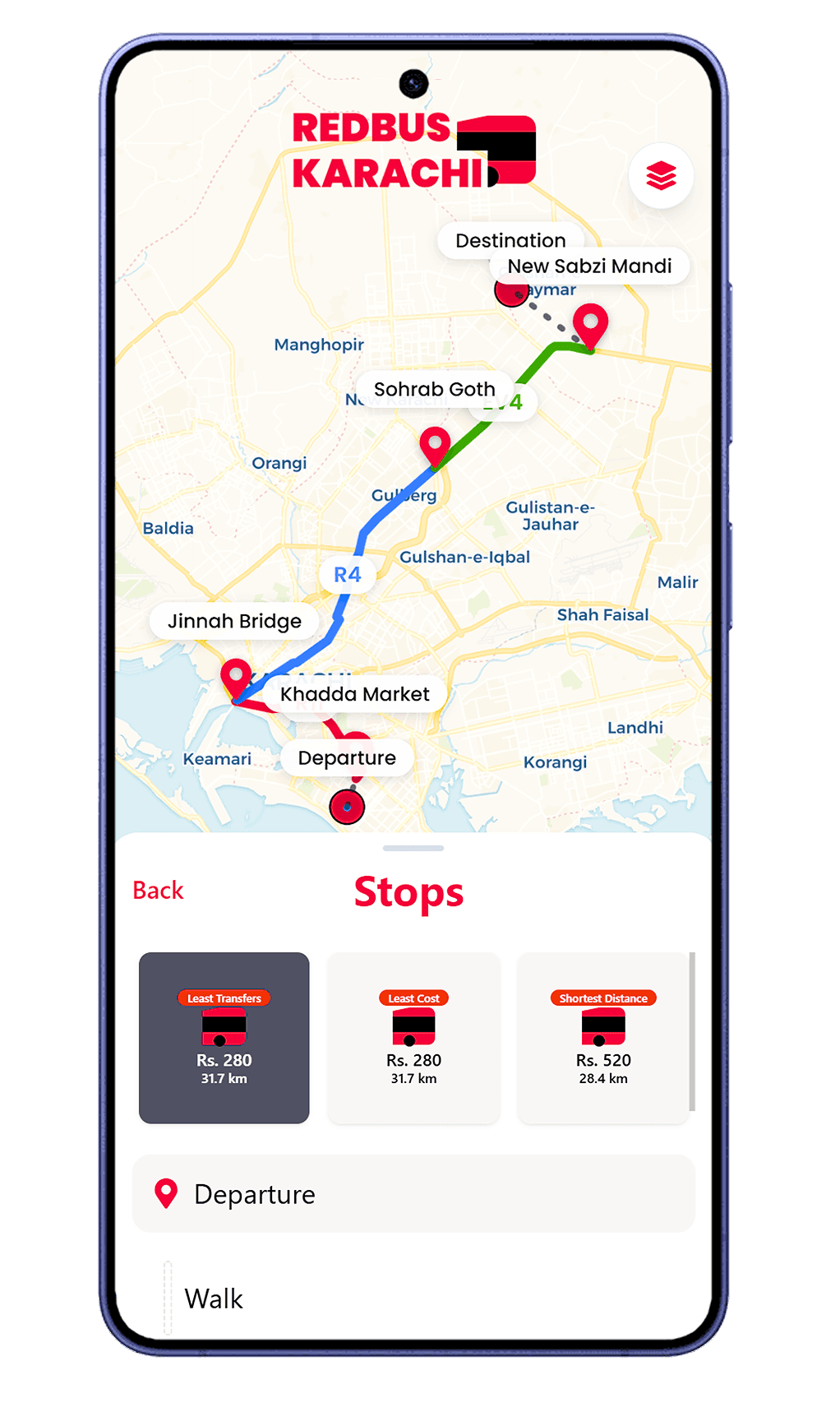
RedBus Karachi models all of these. When you search for a destination, the app picks the most reasonable chain of buses across these corridors.
Shortcuts experienced commuters use
After enough trips, regular commuters stop reading the bus and start reading the city. A few patterns that help:
- Landmarks are more reliable than stops. Karachi's bus stops are often unmarked; major landmarks (malls, hospitals, university gates) are universal.
- Buses run on a regular headway, not on demand. PBS buses leave every 15 minutes in peak hours and every 30 minutes off-peak. In rush hour this means more frequent service — but also more crowded buses.
- The conductor is your best source of information. Before boarding, ask "kahan se jayega?" (where does it go?) and the conductor will tell you the destination. Most conductors are honest and helpful.
- Keep a small buffer. Plan to arrive 10–15 minutes before you actually need to. Bus travel in Karachi is reliable in duration but unpredictable in waiting time.
- Numaish is the central hub. Almost every R-series, EV bus, and BRT line passes through Numaish. If you're ever lost, head to Numaish and you'll find a way to your destination.
How RedBus Karachi models this
The app's route planner works on the same mental model: a graph of stops, routes, and transfer points. When you search, the planner searches this graph for the shortest reasonable chain of buses. The fare shown is the sum of the per-leg fares for the recommended chain (Rs. 80 per leg for trips up to 15 km, or Rs. 120 per leg for trips above 15 km).
If you want to dig into a specific route, the Quick search feature in the app lets you look up any bus route, stop, or area in seconds.
What's next
For a practical look at how much a trip should cost and how payment usually works, read Karachi bus fare zones and payment guide.