

Karachi bus fare zones and payment — a practical guide
How Karachi bus fares are calculated on the modern People's Bus Service, the new AFC smart card system, and how to pay on a typical bus.
By RedBus Karachi Team
Karachi bus fares are famously low — a typical trip across the city costs less than a cup of tea. With the arrival of the modern People's Bus Service (PBS), fares have become much more predictable: Rs. 80 for all routes up to 15 km, and Rs. 120 for routes above 15 km, per person per ride (as updated in 2026). This guide explains how fares actually work, what the RedBus Karachi app estimates, and how to pay on a typical bus.
The two pricing models
Karachi's buses use one of two main pricing models:
1. Flat fare (the People's Bus Service)
The modern red PBS buses — both the standard R-series (R1 through R13) and the electric EV-series (EV1 through EV5) — charge Rs. 80 per person per ride for all routes up to 15 km, and Rs. 120 for routes above 15 km. The 15 km threshold is roughly the difference between a typical in-city corridor trip and a longer suburban run (e.g., the EV routes from Bahria Town).
This is the simplest and most predictable model. The fare depends only on whether your trip crosses the 15 km threshold, with the conductor confirming the route when you ask.
2. Distance-based and zone-based fares (older buses)
The older green-and-yellow buses and the orange minibuses still use distance-based or zone-based pricing. The conductor counts zones (or kilometres) as the bus moves and tells you the fare when you board or when you ask, "kitna hua?" (how much?).
For example, an older route might charge:
- PKR 30 for the first zone
- PKR 50 for two zones
- PKR 80 for three or more zones
This model is less common on the modern red buses but still applies to many of the older routes that run alongside them.
The AFC smart card — the future of PBS payment
The Sindh Government recently launched the Automated Fare Collection (AFC) system for the People's Bus Service. Commuters can now use prepaid, tap-to-pay smart cards instead of handing cash to conductors. The card is available at major stops and online; you top it up with a balance, then tap on entry and tap on exit.
The smart card is the future of PBS payment — it's faster, reduces the cash-handling hassle, and integrates with the official PEOPLES BUS SERVICE app for balance tracking.
Note on the official PBS app: The official PEOPLES BUS SERVICE app frequently glitches, crashes, and shows inaccurate live tracking (per App Store user reviews). The RedBus Karachi app is built specifically to fix those frustrations — faster, more reliable, and tuned for how Karachi commuters actually plan their trips.
What the RedBus Karachi app shows
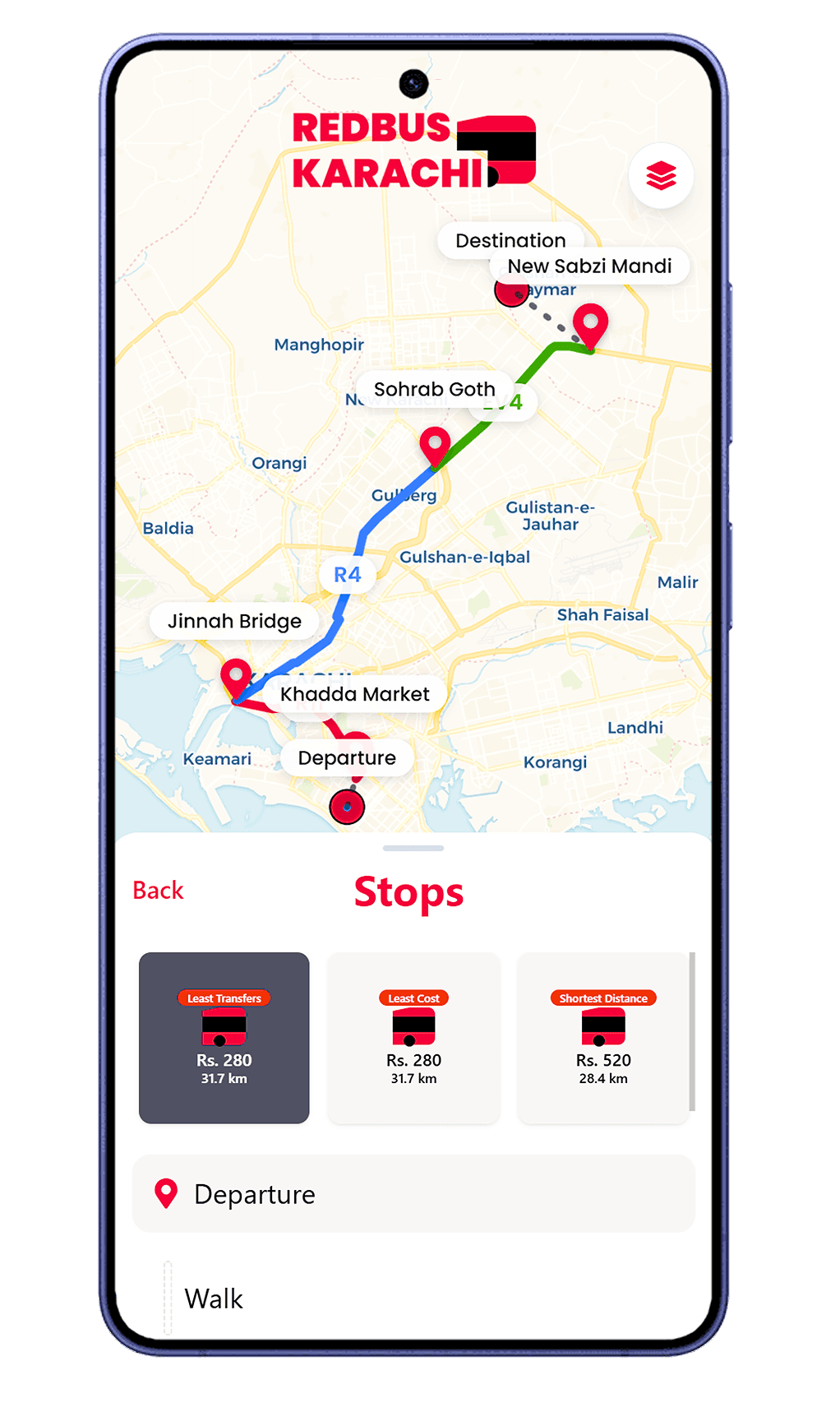
The RedBus app shows an approximate fare per leg for every bus in your chain. For modern PBS routes, the estimate is straightforward — Rs. 80 per leg for trips up to 15 km, or Rs. 120 per leg for trips above 15 km. For older or mixed-route trips, the app uses the typical fare for the route, even when the pricing model is distance-based.
The fare shown is a planning number, not a price guarantee — always confirm with the conductor before paying.
If your actual fare is consistently different from the app's estimate, that's useful data. Email us at surgestudioshq@gmail.com with the route, the destination, and what you paid, and we'll update the network.
How to pay
Two ways to pay on PBS buses:
1. Cash (still widely used)
- Carry small change. Most fares are Rs. 80 (or Rs. 120 for longer routes). Larger notes (PKR 500, PKR 1000) are often refused because conductors can't make change.
- Pay when you board. Hand the fare directly to the conductor at the front. On a few routes, a "fare collector" walks through the bus later — watch what other passengers do.
- Hand the fare forward. In a crowded bus, passengers pass the fare hand-to-hand toward the conductor. Your change comes back the same way.
2. AFC smart card (the new system)
- Top up your card at any major stop or through the official PBS app.
- Tap on entry when you board.
- Tap on exit when you get off.
- The fare is deducted automatically; your remaining balance shows on the card reader.
What if the conductor asks for more than the app says
This happens. It usually means:
- The bus is on a different route than the one you planned
- The fare has changed since our last update
- The conductor is overcharging — more common at night or on tourist-heavy routes
If you're not sure, ask a fellow passenger what they paid. A quick "aapne kitna diya?" (how much did you pay?) is the local way to verify a fare.
Discounts and concessions
There is no formal concession system across Karachi's buses, but in practice:
- Pink Bus — free for girls under 5, Rs. 80 or Rs. 120 for adult women commuters (matching the standard PBS fare for the trip distance).
- Students sometimes get a small discount on certain routes — ask when boarding.
- Senior citizens are usually allowed to pay a reduced fare, though it's not enforced.
These vary by bus and conductor, so don't rely on them for a tight budget.
What's next
For a broader look at how the network is structured and how to read the route numbers, read Understanding Karachi bus routes: a local's guide.